Why I Read Polymarket Every Morning Instead of the News
I’ve replaced my morning news with Polymarket: real-money bets that cut through noise, probabilistic signals on geopolitics and markets, and an automated Obsidian briefing via the API and Claude, despite Swiss geo-blocks.


Prediction markets are a better signal than traditional news
There is something fundamentally broken about the way we consume information today.
Newspapers and news channels tell you what happened. Analysts explain why it happened. But nobody really puts money on what they think is going to happen. That's where Polymarket changes everything.
Polymarket is a prediction market: thousands of people around the world bet real money on questions like "Will there be a ceasefire in Ukraine before June?", "Will the Fed cut rates in April?", "Will Bitcoin exceed $150,000 this year?" The price of a contract — between 0 and 1 dollar — directly reflects the collective probability that the event will occur.
What makes this radically different from the news is that people trading on Polymarket are putting their own money on the line. When a journalist says "tensions in the Middle East are worrying", they risk nothing. When a trader buys a 62% probability contract on Israeli military action in Gaza, they are genuinely betting on it. This difference changes everything about the quality of the signal.
Prediction markets have a remarkable property: they aggregate the opinions of the best-informed people, not the most media-savvy ones. A former diplomat, a risk analyst, a field journalist — if they have information others don't, they will exploit it. Their trade will move the price. The market thus becomes a detector of what the truly informed think, well before that information becomes public.
In practice, what interests me is not so much the absolute price of a contract, but its movement. A market moving from 35% to 58% in 48 hours tells me something is happening — that well-informed people have changed their minds, and the situation is evolving. It's an early warning signal that the next morning's headlines won't give me.
For me as an entrepreneur and investor based in Switzerland, this is a first-class source of strategic intelligence: on geopolitics, on central bank decisions, on the future of AI regulation, on market stability. Information that has a direct impact on my decisions.
A Note on Access — Switzerland Blocks Polymarket
There is one practical complication worth mentioning: Polymarket is not freely accessible from Switzerland.
Under Swiss gambling law, the CFMJ (Federal Gaming Board) requires Swiss ISPs to block websites classified as unlicensed gambling platforms. Polymarket falls into this category. The block operates at both the DNS and IP level, which means that simply using a VPN is not always enough — some VPN providers route traffic in ways that still trigger the block.
Building this system required working around these restrictions technically, without going into details here. It's a solvable problem, but it adds a layer of complexity that anyone replicating this setup in Switzerland should be aware of from the start.
What I Built
I automated this intelligence process by building a small system that runs every morning at 10am on my Mac Mini.
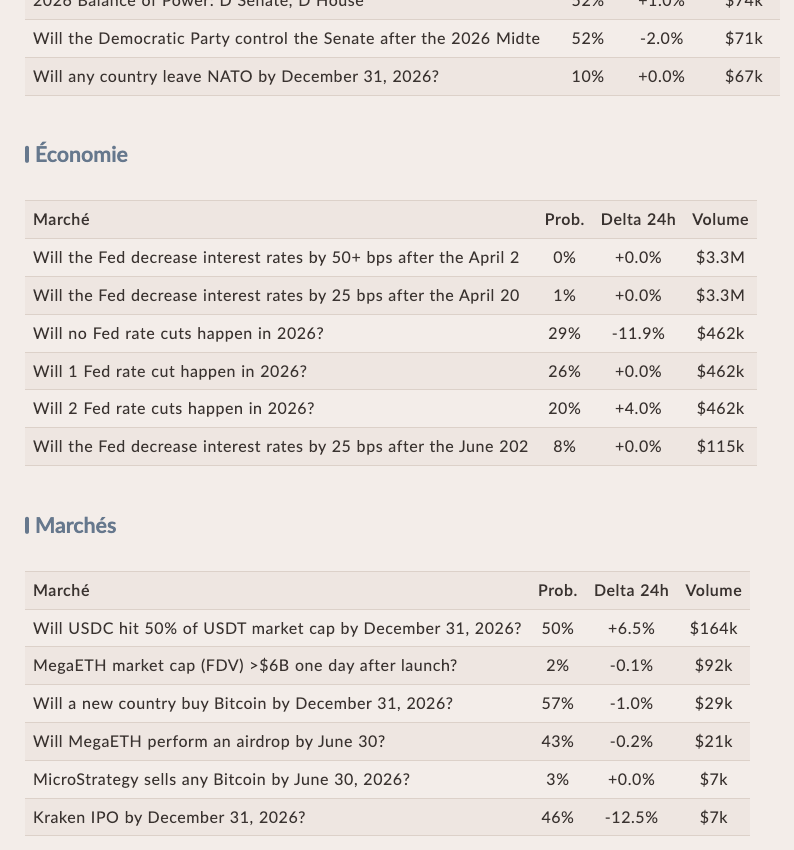
The system works in three steps. First, it queries the Polymarket API and retrieves the most significant active markets, organized by theme: geopolitics, politics, economics, financial markets, technology and health. It automatically filters out anecdotal markets to keep only those with real strategic relevance.
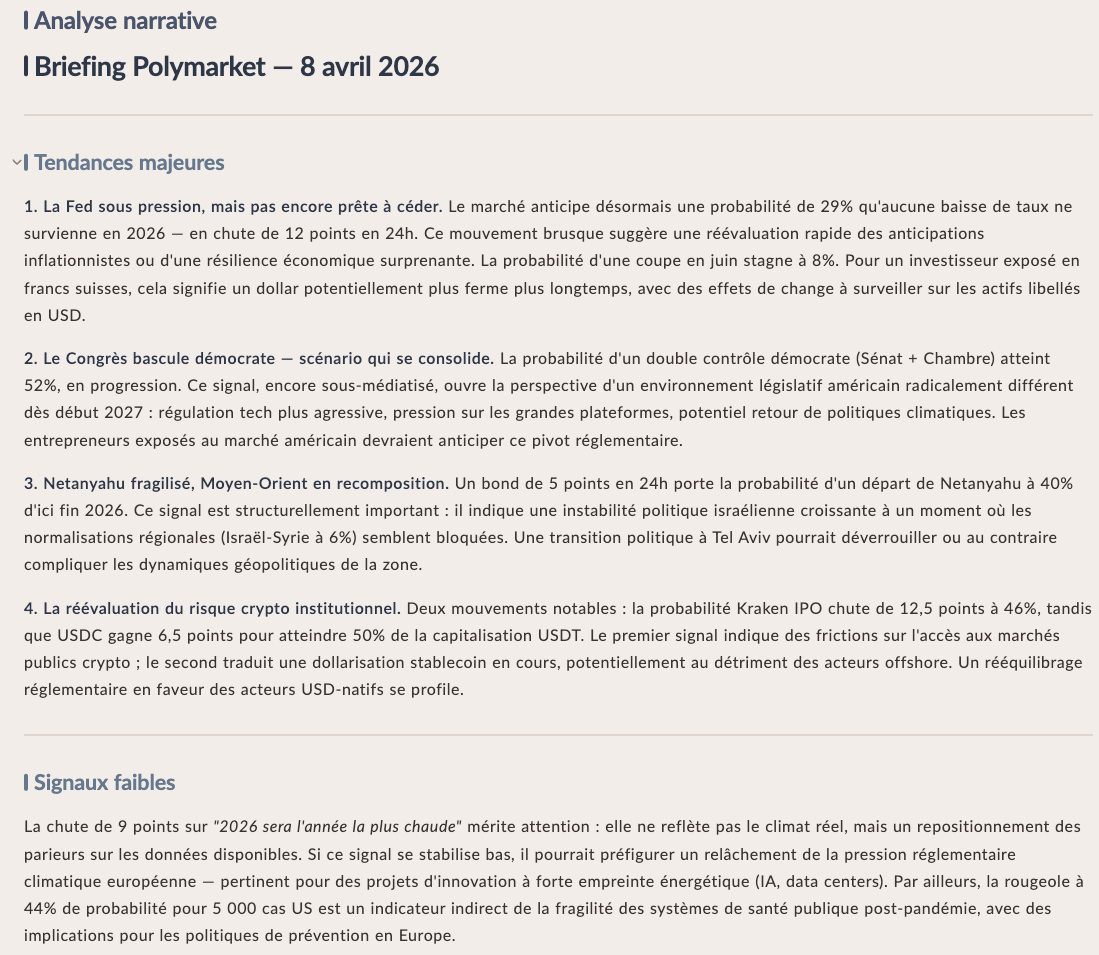
These data are then sent to Claude — Anthropic's language model — with a personalised context specifying who I am, what I care about, and how I want to be informed. Claude then produces a narrative analysis: it identifies major trends, weak signals, and formulates concrete implications for my activities.
Finally, everything is automatically deposited in my Obsidian vault as a structured Markdown note, with raw data, themed tables, and the narrative analysis. Every morning at 10am, I open Obsidian and the day's note is there.
The result looks like a personalised analyst briefing — not a press summary, not a Bloomberg alert, but a reading of the world calibrated to what matters to me.
Want to Do the Same?
I won't detail the code here — it would be long, technical, and that's not the point of this post.
What I can say is that this system is built entirely on publicly available tools: the Polymarket public API, the Anthropic API, Python, and Obsidian. Nothing proprietary, nothing complex to maintain.
If you're curious and want to set up something similar on your end, I'm happy to share the files and walk you through the method. Just reach out directly.